
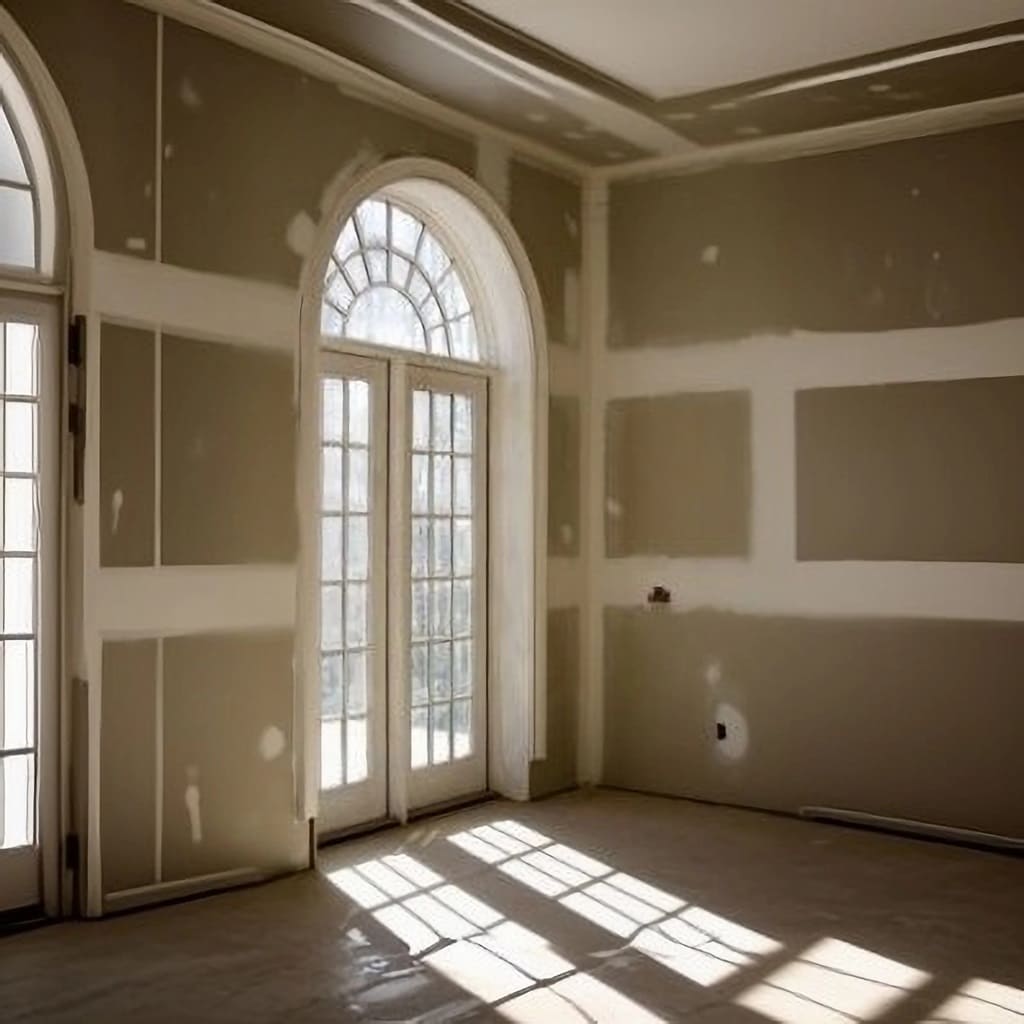
The reputation of drywall is terrible. Give a person a bucket of mud and he/she will immediately see the living room where there won’t be any place without the thin film of white powder.
I get you – it’s dirty work.
But, in reality, fixing drywall and installing it isn’t black magic. There is no special degree in this from any prestigious university needed. It’s just the mechanical work – cut, fasten with screws, put the tape, apply mud, and sand the surface. Missing some steps is noticeable, taking appropriate time for everything will result in perfectly covered holes.
Here you’ll find out how to put walls together in various cases. I know little about terminology now, but, whatever it takes, from filling holes where doorknobs will go to putting new Gyproc sheets in a cold Canadian basement, here you’ll learn how to do it.
Buying Materials: What Actually Works
Before anything is cut off, one must have the correct materials. Shopping at a store such as Home Depot or Rona can be daunting since there are twenty kinds of mud and tape.
The essential components are listed below.
The Drywall: Interior walls require 1/2 inch thick drywall. Ceiling normally uses 1/2 inch or 5/8 inch drywall. Green boards are used for bathrooms or wet areas. The green boards are moisture resistant. However, if one is working in Canada and plans to board an exterior wall, ensure that there are no leaks in your vapor barrier or insulation material before putting up any board.
The Joint Compound (Mud): There are two kinds of joint compound. You either opt for pre-mixed or setting type. Pre-mixed mud comes in a bucket. Its drying process involves evaporation of water. The other type is found in bags and is sold as a powder. Mixing this with water results in drying through a chemical process in 20, 45 or 90 minutes depending on the product.
Conclusion: Pre-mixed is ideal for beginners since they give enough working time. However, when filling up deep holes, then go for the bagged setting type, e.g., Sheetrock 90. Why? Pre-mixed dries out quickly if put up thickly resulting in shrinkage and cracking of the board.
The Tools:
- A utility knife with fresh blades.
- A drywall saw (looks like a serrated dagger).
- A 6-inch and a 10-inch taping knife.
- A drywall screw gun or a drill with a dimpler bit.
- Fine-grit sanding sponges.
How to Install Drywall From Scratch
If you are framing out a new room, installing the drywall is actually the fast part. Mudding is what takes days.
Cutting and Snapping
The drywall is neither cut nor scored using a saw unless there is going to be room made for windows or an electrical plug to be installed. The cutting is achieved by scoring and snapping off the piece.
Measure your cuts. Use a utility knife and a T-square to score a line on the paper side of the drywall. It does not matter whether the line goes into the chalky portion because all that is needed is to cut through the paper surface.
After scoring the drywall sheet, flip it and break it along the score line. This should easily break along the required path. All that remains to be done is to use your knife again along the break line on the other side.
Hanging and Fastening
The sheets must always be installed horizontally and not vertically on the wall since it will make the seam easy to tape and mud.
Apply pressure on the sheet to press it firmly against the frame. Fix the sheet by driving screws into it at intervals of 12 to 16 inches in the studs.
This is where everyone gets it wrong. You have to drive the screw just below the paper surface. But the catch is that you must not drive it into the brown paper layer. Once the screw cuts through the brown paper layer, it becomes worthless. Unscrew it and fix another screw an inch from the existing one. Buy a unique drill bit known as a “dimpler.”
DIY Drywall Repair: Fixing the Messes
That is why people tend to search for help. Life happens. Your children will scatter their toys about, somebody will bang the door too hard, or the plumber will cut large squares out of your ceiling in order to fix a broken water pipe.
Drywall repairs are determined by the size of the problem. There are some methods that cannot be used when fixing a small hole from a nail or even one as large as your foot.
Tiny Dents and Nail Holes
Now that you have taken the picture hook off the wall, you don’t need the tape anymore.
Push on the hole using the edge of the putty knife until it collapses into one. It should now have a depression in it. Take some spackle or drywall mud and use the 6-inch putty knife to apply it over the hole.
Allow this time to sit for about an hour. If it shrank, then do this again. Now, sand and paint.
Doorknob Damage (The Mid-Size Hole)
To fix the fist-sized hole or the even doorknob-sized hole, a bridge is required. One cannot use mud to patch the empty hole because the mud will simply fall right through.
Create what is known as the California Patch.
Get a square of scrap drywall about two inches larger than your hole on all sides. Flip the square upside down and cut out the paper in the shape of your hole. Break the drywall around the cut line and remove the core but leave the front part of the drywall in place.
In other words, you have now got yourself a drywall plug with the two inch paper border.
Spread a border of mud around the edge of your hole. Fit the plug into the hole. Now, with the help of a knife, press the paper border against the wall and expel any excess mud. Time to paste the paper tape over the mud.
Once it dries, give it another coat of mud.
Massive Holes and Water Damage
If there is a possibility of a leakage of water or someone falling into the wall, then the paper patch will never work, and there is a necessity of redoing the entire construction.
One may have to use the utility knife or drywall saw to remove the damaged drywall, which will help one create a rectangular opening where he can reach at least half of the studs present in both sides of the wall.
But in case one finds it difficult to locate the studs on the other side, there arises the need for some kind of backing. For this, two boards will have to be made of scrap wood and put inside the opened part, fixed to the studs on the opposite side of the hole.
The new pieces of drywall have to be cut according to the dimensions of the opening created and then attached to the newly created backing board by screws.
Fixing Cracks and Ceiling Nightmares
Ceilings are awful to work on. Gravity fights you the entire time, and the dust falls right into your eyes. Wear safety glasses. Seriously.
Stress Cracks
Where there is an irregular crack in the wall or in the ceiling, simply painting over the crack will do nothing good to fix the problem. In a matter of months, the crack will show itself again since the houses will be displaced, due to the fact that wooden frames expand and shrink depending on the temperature.
The cracks will need excavation, and for that, a person will need to make a cut along the crack using a knife. It is intentional that one should cut a v-notch in the crack. After that, the dirt should be cleaned out of the crack, filled with mud, and paper tape should be applied to the crack.
Truss Uplift
When you notice that there is a crack directly at the intersection of your ceiling and your internal wall, it means that the problem of truss uplift is the cause. In the winter period, the trusses within your attic rise up, making separation happen between the ceiling drywall and the wall.
How can you handle the issue? Make sure that the ceiling drywall is not fixed close to the wall; otherwise, it will float around the edge with the wallboard pressing down on the ceiling. If you have cracks on your ceiling, you can install crown molding only on the ceiling.
Mudding and Taping: Where Things Go Wrong
That is how you differentiate a good surface from a bad one. It is not a case of making an elevation over the crack while mudding. It is just a matter of feathering it to the extent that even your naked eye can’t detect any protrusion.
Paper Tape vs. Mesh Tape
Why everyone opts for mesh tape? It is because the mesh tape has adhesive properties, meaning there is no need for any mud when taping the seams. Just apply the tape over the mud and you are ready to move forward.
Wrong! There is something bad about the mesh tape. It is weak compared to the paper tape, so when mesh tape and normal mud get together, it will cause joint cracking. You can use the mesh tape in conjunction with only powdered-type mud.
If you are working with the common pre-mixed mud, then you need to use paper tape.
You must apply the mud layer first, and then apply tape over the mud surface. Use the six-inch blade and press it firmly on the tape so as to eliminate the extra amount of mud from the joints. Beware! Do not press too hard to avoid bubble formation.
The Three-Coat Rule
Three coats of mud are necessary for good drywall repair work.
The first coat is known as the taping coat. Mud application is essential when taping. Ensure that the coating remains narrow, and the mud dries fully.
The second coat is referred to as the fill coat. At this stage, a 10-inch knife must be used. Mud must be applied on top of the tape, going further than the borders of the first coat. The pressure applied to the knife’s edge is essential in applying mud. This ensures that the mud layer becomes very thin. The center remains slightly thicker.
The third coat is called the finish coat. Mud application is done to ensure that air bubbles and knife marks are filled.
What often occurs is that individuals apply a substantial amount of mud at once, thinking they can smooth out the surface by sanding it. This is not the case. Mud application takes three days, and it shrinks, thus taking six hours to sand. Thin coatings should be applied.
Sanding Without Ruining Your House
The finishing touch is sanding.
Use a high-gloss sanding sponge. Make sure to turn off your heating and cooling systems prior to sanding. You don’t want the HVAC system sucking up the gypsum dust from your patch and circulating it throughout your home. Cover doorway openings with plastic sheeting.
Use either a work lamp or a flashlight for this process. Press the light flush against the wall, illuminating your patch at an angle. The shadows cast by the light will make all irregularities evident.
Apply gentle circular strokes when sanding. Concentrate your efforts on the area where the mud and wall meet. It must be perfectly smooth. Avoid over-sanding the center of your patch or you will bring your tape work to the surface.
If you have a problem with dust, wet sanding can be a solution for you. You just need to take a wetted grouting sponge and use it to sand the edges of the dried out mud, and there will not be any dust left. This task requires some labor and skills, but if you have to fix something in a ready room, then you really need to know how to do it.
The wall must come into contact with your hands, and if it feels like it is smooth enough, then just clean it with a dry microfiber cloth.
Primer and paint should go here, and you shouldn’t touch anything anymore.
It is true that no one enjoys drywalling, but you can make it yourself without having a specialist if you act calmly.